
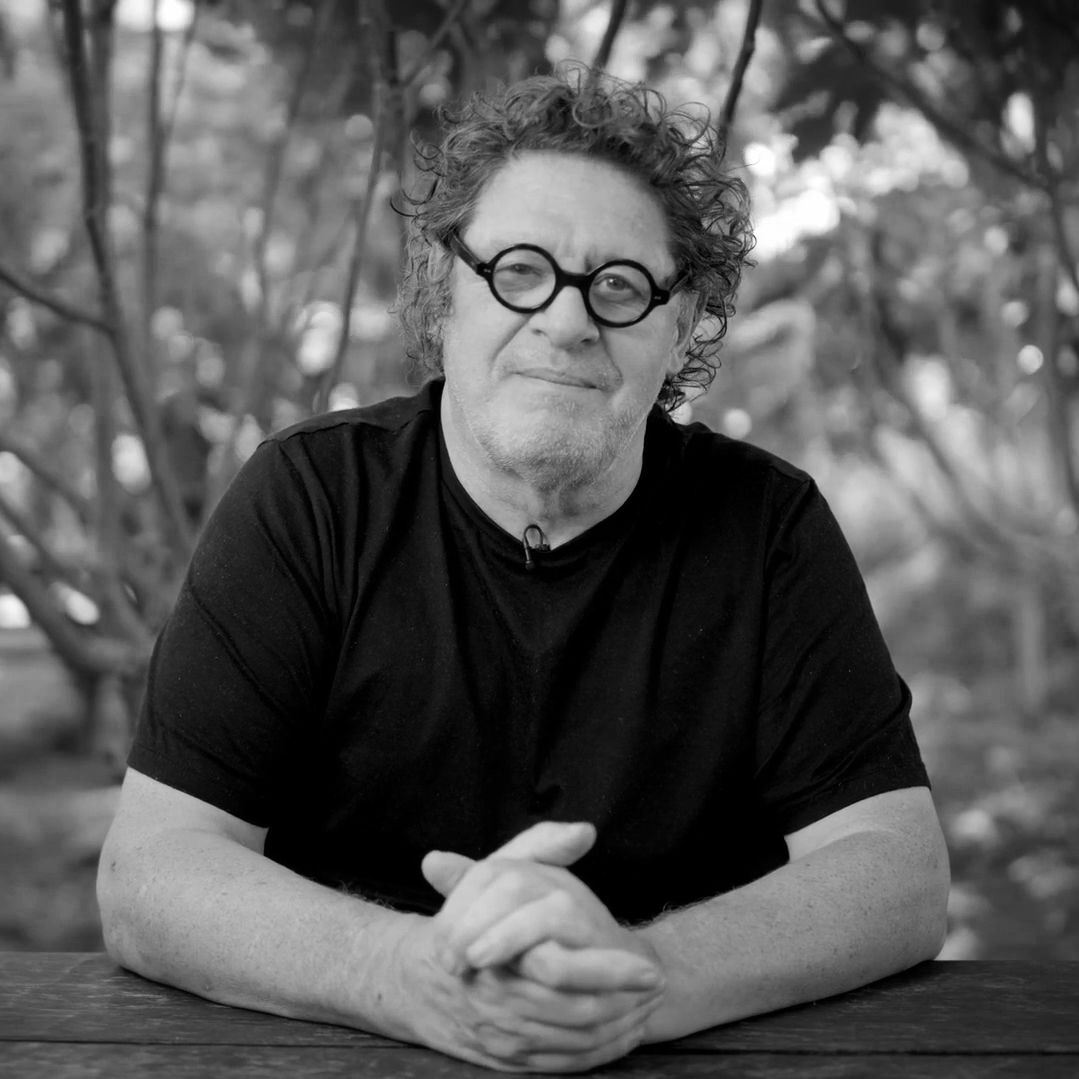
A profile · In five chapters

Marco Pierre
White.

The rebel who became
Britain’s first three-star chef.
The renouncer who gave them back.
The master who teaches still.

33
Age when awarded
three Michelin stars
III
Stars held,
then returned
1999
Year he walked
out of the kitchen
Marco Pierre White
Marco Pierre White From the archive · MMXXIV

“My mother was my first apprenticeship.”

Marco Pierre White was born on the 11th of December 1961 in Leeds. His mother, Maria-Rosa Gallina, was from the Veneto — a region where food is not entertainment but the structure of daily life. Marco’s earliest memories are of her at the stove, and of a boy at her elbow watching her cook.

“I was my mother’s apprentice,” he has said. Before the stars, before the brigades, before the kitchens of London, the first kitchen he worked in was hers. She taught him what Italian mothers teach their children — that food is care, that a plate is how you say I love you without needing to.

He left school without qualifications and took his first job at the Hotel St George in Harrogate, on £16 a week. He was a teenager. He apprenticed next at the Box Tree in Ilkley. At sixteen, he travelled south to London — with, by his own account, a small bag of clothes, a box of books, and almost no money. Humble origins, no shortcuts, and a work ethic that was already unmistakable. He talked his way into the kitchens of Le Gavroche under Albert Roux, La Tante Claire under Pierre Koffmann, Le Manoir aux Quat’Saisons under Raymond Blanc, and Chez Nico under Nico Ladenis. He was learning from the great chefs of his generation now. But the first teacher was already settled in him.

He became the youngest chef ever to hold three Michelin stars.

Harveys opened in Wandsworth in 1987. Marco was twenty-five. Within a year he had one Michelin star. By 1990, two. In 1995, aged thirty-three, he was awarded the third — the first British-born chef to hold three stars, and the youngest ever to do so.

The press called him the “Jagger of the Aga.” The television cameras followed him. The kitchen was chaos. Gordon Ramsay, Mario Batali, Curtis Stone, Phil Howard, Shannon Bennett, Stephen Terry — all trained there. Most of them left with stories.

Marco pushed them because he was being pushed by something older and harder. “You are only as good as your last service,” he would say. It was not a slogan. It was the condition of his life.

You don’t become a chef by learning recipes. You become a chef by learning how to think.

Marco Pierre White

By the late 1990s, he owned the Oak Room at Le Meridien. His cooking was untouchable. His name was worth more than the restaurants that carried it. And he was, by every measure he could name himself, unhappy.

“I was being
judged by people
less qualified than
myself to judge me.”

Marco Pierre White · On returning the stars

On the 23rd of December 1999, he handed his three stars back.

It had never been done. Chefs lost their stars when their cooking declined or their restaurants closed. Marco returned his while at the height of his powers, in a kitchen still performing at three-star standard. He did it because he had decided the theatre was no longer worth the price.

“I gave them back,” he said, “because I was being judged by people less qualified than myself to judge me.” The comment was characteristic: blunt, exact, entirely serious. He was thirty-eight. He would never again cook for Michelin.

What followed was a long retreat. He moved out of central London. He bought the Rudloe Arms, a country house hotel near Bath. He started walking in fields. He started collecting — Francis Bacon, Damien Hirst, photography, antique English furniture. He fished. He shot. He read.

The public persona continued: television shows, restaurant ventures, a sometimes ungainly afterlife in celebrity culture. The private person, the one who mattered to him, receded.

He has not cooked for money in more than twenty-five years.

The man at the Rudloe Arms is not the man at Harveys. He cooks — for friends, for family, for the people who sit at his table. He walks. He teaches, carefully, the people he considers worth teaching. He is, by his own phrasing, at peace.

“For me,” he says now, “food is about generosity.” It is a line that would have sounded soft thirty years ago. At sixty-four, it sounds structural — the thing underneath everything else. Generosity of attention. Generosity of craft. Generosity of patience, which is perhaps the form of generosity most demanding of character.

He has refused, repeatedly, to come back to Michelin cooking. He has refused, repeatedly, to open a signature restaurant of the old kind. What has not been refused — what he has, instead, given thirty years of his life to — is the work of knowing what is worth passing on.

“Now I want to inspire people to cook.”

At sixty-four, Marco is at the point in his life where the work is no longer about him. It is about the people who will cook after him.

He wants young people to cook. He wants the kitchen to be a career people enter deliberately, proudly, for the rest of their lives — not a stopgap, not a stepping-stone. And he is unusually clear that the kitchen that needs this most urgently is not the restaurant kitchen. It is the care home kitchen. Cooking for the old, the vulnerable, the people whose meal is the most important part of their day — this is where he believes the next generation of serious British chefs should be headed.

That is what the Academy of Culinary Excellence is for. Eight volumes, one hundred and sixteen chapters, taught to the chefs and care teams who hold the plate. Written in his voice, to his standard, for the kitchens he has come to believe matter most.

When he is not at the Academy, he is at Foodworks in the Lake District — a kitchen of another kind, where he makes food he is willing to put his name on. It is the same argument in a different form: the standard, in the place the standard can be held.

“I am not here to judge,” he has said. “I am here to teach.”

On the Academy · On the Collection

Now his standard
is yours to learn.