
The Standard
A new standard for
the care home kitchen.
We exist to bring one man’s lifetime of craft to the kitchens that need it most. Not as a masterclass. As a Learning Collection.
I
Why the Academy exists
The plate in care
is the one that matters most.
For a resident in a care home, the meal is rarely just the meal. It is the structure of the day. It is the moment of attention. It is, often, the most important interaction the resident will have. The plate carries weight that no restaurant plate ever has to carry. And yet the standard of food served in care has been allowed to slip. Budgets shrink. Trained chefs are harder to find. The work is treated as catering rather than craft. The conditions of the resident — texture-modified diets, dementia, reduced appetite, arthritis — have been met as constraints to be coped with rather than as the discipline that defines them.
The Academy exists because Marco Pierre White has decided to put his standard, his name, and his lifetime of craft behind the kitchens that need it most. The Learning Collection — eight volumes, one hundred and sixteen chapters — is the means by which that standard is transferred into care. Each chapter has been written, edited, and checked by Marco himself. The work is delivered into care kitchens by chefs trained to teach it, and held to a regulated apprenticeship standard from start to finish. It is the answer to a single question: what does Marco’s lifetime of craft owe to the people who need it most?
The standards I was
trained to are the standards
I have refused to lower.
Marco Pierre White
The Marco way
What it looks like when a care kitchen cooks the Marco way.
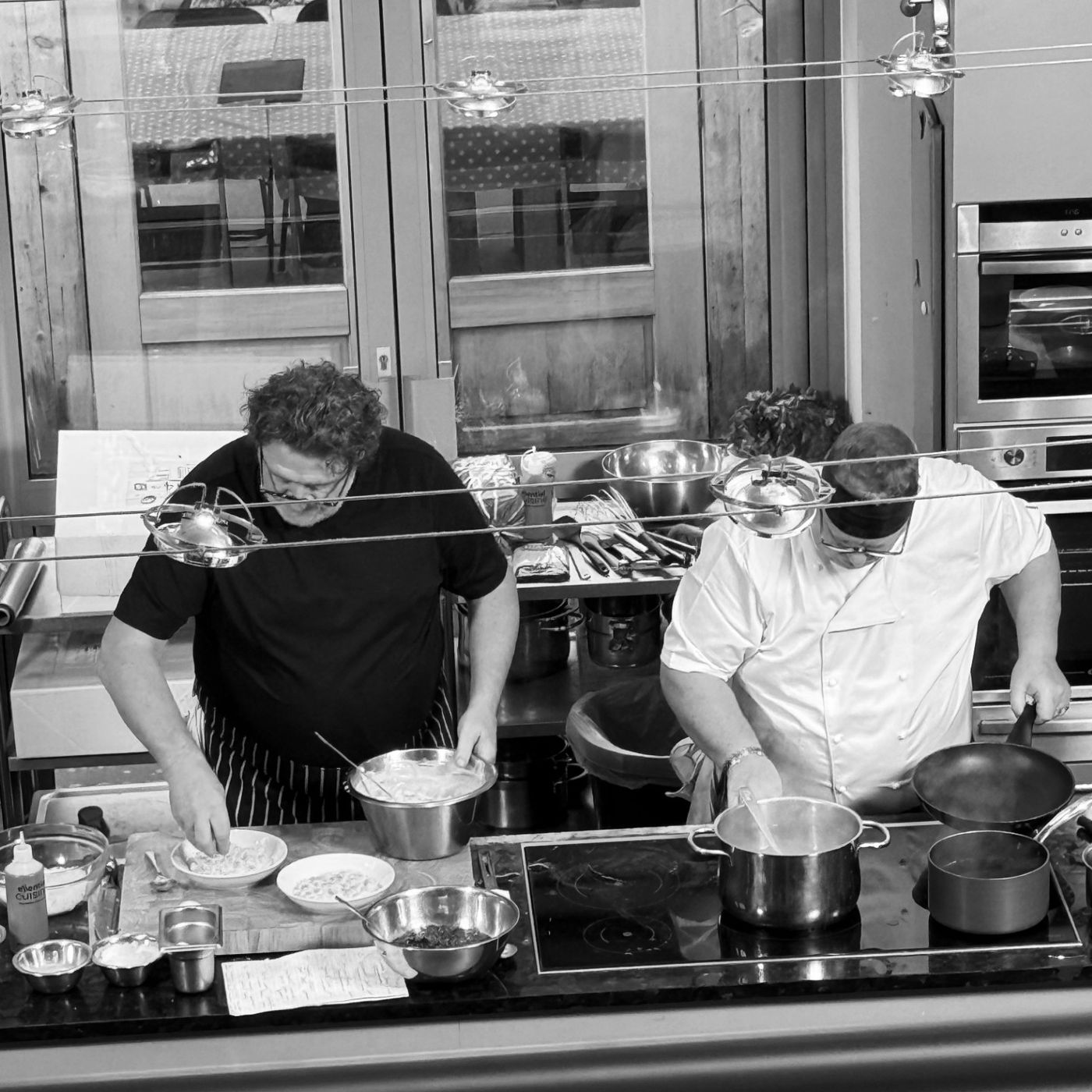
So what does the Marco way look like, day to day, in a care kitchen — when a chef is actually doing the work?
It looks like a kitchen that treats the care plate as the hardest plate in the trade, not the easiest. Where texture-modified diets are made with the same precision as a restaurant main course, and served with the dignity of one. Where the kitchen has thought about the resident whose hand cannot grip a knife before the plate is sent — not after.
It looks like menus that change. Where a person with thirty years of food memory is not given the same four rotations for the rest of their life. Where variety is built in, because a menu without variety stops being personal and becomes assumption.
For me, food is about generosity. There is no better place to practise it than where someone depends on you.
Marco Pierre WhiteIt looks like every plate arriving properly hot. It looks like the handover from kitchen to care staff being treated as part of service, not as something that happens after service is done. It looks like presentation — because presentation is how the kitchen tells the resident that this plate was made for them, and not for everyone.
It looks like the allergens folder being kept current on a Tuesday, not on the day before inspection. It looks like the chef knowing the names of the residents with dysphagia on their ward. It looks like a kitchen that never describes a meal with the word “just.”
The hard thing isn’t reaching the standard once. It’s reaching it every day, in every kitchen, in every home.
Marco Pierre WhiteAbove all, it looks like a chef, and a kitchen, and an operator who have quietly decided that the people they are cooking for deserve the full weight of the craft. Not the version that fits the budget. Not the version that fits the rota. The full weight of the craft — applied with care, every day, to the hardest plate there is.
That is the Marco way. That is the standard.
 The standard, in practice
The Seven Principles
The standard, in seven.
Simplicity
Stripping a dish back to what truly matters. Not plainness — clarity. In care, simple food is easier to recognise, easier to eat, and more likely to nourish.
Warmth
Both temperature and feeling. The plate must arrive properly hot, but it must also feel like it was made with care. Warmth is the first signal of attention.
Variety
Choice, identity, dignity. Residents still have histories, preferences, memories. A menu without variety stops being personal and becomes assumption.
Timing
The kitchen works to the resident’s moment, not the other way round. Food must arrive when the person is ready to eat — not simply when the kitchen is ready to serve.
Consistency
The habit of excellence, especially on difficult days. Safe, reliable, properly executed every time. Particularly with texture-modified diets, this is not just quality — it is clinical safety.
Service
The moment the meal fulfils its purpose. Presentation, communication, handover, the final receiving of the plate. Service is where the kitchen’s values become visible.
Dignity
the principle that ties the others together.
It means seeing the person behind the dietary code, respecting their history, and never allowing food to become careless, anonymous, or dehumanising. Dignity is not about performance when someone is watching — it lives in the unseen everyday moments.
Simplicity respects capacity, warmth respects comfort, variety respects identity, timing respects rhythm, consistency respects trust, service respects humanity, and dignity respects the person.
The terrain it has to hold
And these are the conditions the standard has to survive.
The Marco way is not a restaurant ideal transplanted into care. It is a standard designed for, and tested against, the real conditions of the British care kitchen — the plates that get harder, not easier, as the day goes on.
Texture-modified diets, structured to the IDDSI framework, without loss of flavour or dignity on the plate.
Familiarity, finger-friendly forms, and the mealtime held as the anchor of a resident’s day.
Nourishment delivered in smaller forms — without compromising the principle that a plate should still be a pleasure.
Food that respects the hand that holds it — cut, served, and presented to be eaten with independence.
Because the meal is often the best part of the day. The plate is only one of its parts.
CQC standards, allergen controls, Natasha’s Law — documented throughout, never left to the day of the inspection.
IDDSI informs the structure. The intention goes further. This is not about meeting a requirement. It is about restoring meaning to food in care.
The Standard, in one line
You are not cooking for a care home.
You are cooking for someone’s mother.
That is the standard.